Diving into the Deep End: Building a 67 Gbps FPGA Data Acquisition System from Scratch
Earlier this year, I stepped into a new role as a Postdoctoral Researcher at the Max Planck Institute for Physics in Munich. Alongside the personal challenge of learning German, I was handed a major engineering objective: design and build a robust FPGA data acquisition pipeline on an AMD Xilinx platform to stream experimental data at ultra-high speeds.
"The catch? Six months ago, I had never actually programmed an FPGA in my life, nor did I know much about their architecture beyond the acronym itself."
Coming from a classic table-top optics and analog instrumentation background, looking at hardware description paradigms felt like learning an entirely alien dialect. But in experimental physics, diving straight into the deep end is practically part of the job description.
The Architecture Blueprint
To achieve the necessary bandwidth constraints, the design utilizes high-speed multigigabit transceivers coupled directly to optical fiber networks. Instead of managing basic sequential code cycles, I had to master concurrent hardware execution loops, clock domain crossings, and strict signal integrity constraints inside the Xilinx fabric.
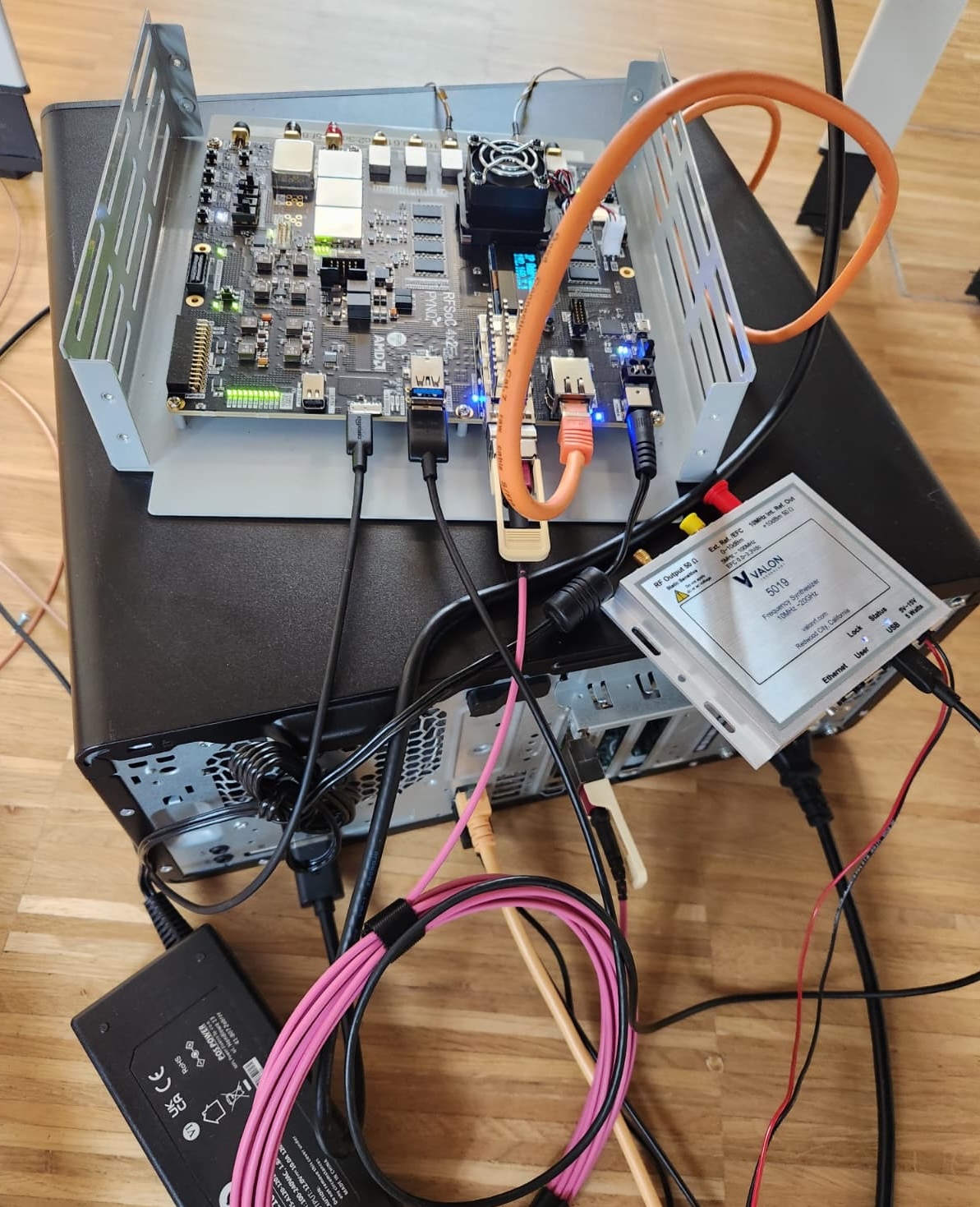
Figure 1: Glimpse of the experimental test bench, routing data dynamically over high-speed optical transceivers.
Hitting the Throughput Benchmark
After weeks of debugging timing violations, parsing data sheets, and fine-tuning hardware pipelines, the system finally hummed to life. The final verification suite demonstrated stable, real-time data ingestion streaming over optical fiber at a sustained throughput of ~67 Gbps.

Figure 2: Active terminal output displaying the measured ~67 Gbps raw physical transfer rate stability profiles.
There is an incredibly unique reward in taking a highly complex technology you know absolutely nothing about, wrestling with its constraints from a clean slate, and building a physical system that meets strict, real-world experimental benchmarks.
On to the next challenge—and back to the German textbooks! 🛠️